|
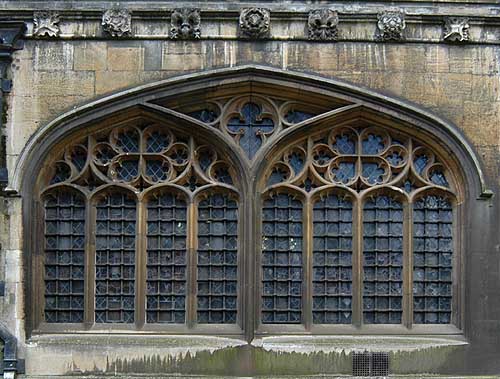
King's
College Cambridge
Gothic architecture was developed at a time when
England and France were often ruled under the same crown. It
was a style that developed simultaneously in Britain and northern
Europe. This detail from King's College Cambridge shows the
delicate tracery, multiple muntin bars and ogee curves distinctive
of the style.
The Gothic style is also related to the many monasteries
throughout Britain, closed by Henry VIII, but still with the
legacy of learning, education and secluded cloistered existence.
|
|
|
Abbey
The Gothic Revival in England
was not simply a revival of a method of working, but more a
revival of all things indigenous to Britain. Ruskin, Pugin,
and the others who backed the revival of the Gothic style were
revolting against the mechanization of the industrial revolution.
Their ideas ultimately led to the Arts and Crafts movement.
Most of the churches built during
the Gothic period are still standing. These, and the residential
or civic buildings that had Gothic detailing, would have had
a huge impact on those emigrating to a new, foreign, and to
them very barren land. In order to understand the impact of
Gothic architecture on the Romantic (19th century) mind, however,
something else has to be considered.
|
|
|
Tinturn
Abbey Wales
During the 13th and 14th centuries, monasteries
grew in size and importance until they were very powerful forces
within the society wielding immense fortunes and huge tracts
of land. By 1530, Tinturn Abbey in Wales had 20,000 sheep and
over 1 million acres of land. In his attempts to unite the country,
Henry VIII dissolved the monastery system in the 1530s. Of the
650 monasteries in England and Wales, a third have gone completely,
another third were transformed into churches, and the final
third were left in ruins.
|
|
|
Tinturn Abbey
Those responsible for dissolving
the individual churches were happy to do so. They helped ‘redistribute'
the steel, glass and wood to make their own barns and homes.
The square blocks disappeared like popcorn. Within twenty miles
of all of these monasteries are gorgeous old homes with very
sturdy foundations. The designs made for a particular spot,
however, the arches, capitals, and pinnacles, would be a dead
giveaway if found in a house, and would remind the occupants
that a holy site had been desecrated. Many of these were consequently
left standing. It is these ruins, scattered across the country,
that left a lasting impression on the followers of the Romantic
movement.
Tintern Abbey alone inspired
countless paintings, poems and stories by Romantics as celebrated
as Turner, Wordsworth and Tennyson. In describing Tears, Idle
Tears, Tennyson said he was inspired by bygone memories.
Ah, sad and strange as in dark summer dawns
The earliest pipe of half-awaken'd birds
To dying ears, when unto dying eyes
The casement slowly grows a glimmering square;
So sad, so strange, the days that are no more.
The settler's of Upper Canada were defenseless
against such lyrics. Gothic arches popped up everywhere.
|
|
|
Eastern
Ontario: Upper Saint Lawrence and Quinte
|
The war of 1812 left many of the farmsteads
along the the banks of the Saint Lawrence in ruins. The
Georgian style buildings were mostly rebuilt in the Neo-Classical
style, but the new buildings created
|
|
by both homesteaders and new immigrants from
Europe were often in the Gothic style, particularly in Kingston
and the Bay of Quinte,
|
|
|
Picton
Another name for Gothic Revival is Jigsaw Gothic
for obvious reasons. The intricate vergeboarding, complete with
crockets, kingposts, finials, and quatrefoils is really breathtaking.
This lovely home, now an Inn, emphasizes the verticality
of the Gothic Revival. The second and third storey windows are
remarkably tall and slender.
|

Picton Ontario
|
|
Madoc
This house in Madoc has beautifully detailed gables
which echo the lancet arch of the window. The woodworking on
the front porch is a masterpiece of design, the structural members
are firmly stated, there is a quatrefoil in the center, and,
again, the lancet arch is echoed. The finials popping up above
the roof give the building a distinctive silhouette.
|

Madoc Ontario
|
|
Madoc
On the gable ends of the house are lancet arches
on the upper level and on the west side, shown here, a bay window
with iron cresting. Both the side bay and the front have segmental
arches on the windows.
The gable end is adorned with a magnificent kingpost
which finished in a pendulum.The vergeboarding is held in place
by ornate brackets.
The finials along the roofline give it a distinctive
profile.
The house is beautifully manitianed.
|

Madoc Ontario
|
|
Madoc
This detail of the front doorway shows a gable
over a lancet arch window. The vergeboarding echoes the window
profile.
The gable over the door has a quatrefoil pattern.
Even the screen door is made with lancet arches and has not
been destroyed by the dreaded metal screen door salesman.
|

Madoc Ontario
|
|
Ottawa
The Parliament Buildings in Ottawa, constructed
in the last decades of the 19th century, reflect the public
buildings in London England and illustrate some of the features
praised by John Ruskin, the foremost architectural critic of
the time. The architect was allowed great liberty in the design
which is a mixture of the following: Gothic,
lancet arches, trefoils,
tracery, Baroque,
iron cresting, and Château,
steeply pitched roofs, and dormers.
Notice that the voussoirs
atop the windows are in a different colour from the other stone
of the building giving a dichromatic
effect, an element that was, again, admired by Ruskin. The windows
themselves have a trefoil pattern
that is repeated regardless of the arc of the window. The roof
is patinated copper that looks very handsome with the red window
detailing.
|

Ottawa Ontario
|
|
Central
Ontario
|
European settlers from both Britain and Germany
made many beautiful buildings in the Gothic style. The Canada
Farmer periodical published plans and
|
|
elevations for the farmhouse which became the
Gothic Revival Cottage, the single most popular home style
in Canada until 1950.
|
|
|
Simcoe
A drive through rural Ontario is likely to provide
many examples of the small Gothic
Revival Cottages in a variety of vernacular
materials. The basic design was promoted in the 19th century
by academics J.C. Loudon and A.J. Downing as well as the Canadian
Farmer (1865) where it is featured complete with construction
drawings for the farmer to build.
Details such as the finials,
bargeboarding, and window hoods
add the Gothic flavor. The scalloping
under the eaves is also medieval. The door detailing, in this
example, is Georgian.
|

Simcoe Ontario
|
|
House
of Heads Guelph
The most impressive stone carving on a private
residence in Ontario is the House of Heads in Guelph.
The shape of the house is a typical L-shaped farm
house. The front gable end is adorned with head shaped corbels
and label stops. The foliage shaped crockets on thehoodmold
of the upper level are the best in the province.
Crockets are usually found on the raking edge
of finials, pinnacles and spires. Here they are on the top edge
of an ogee shaped hood mould. Above the lower windows is a cornice
with a pointed arch frieze and battlementing along the top.
Two heads adorn the ends.
|
|
|
House
of Heads Guelph
This detail shows the gable end in detail.
The hoodmolds on the upper level are in the shape
of ogee curves. At the end are label stops in the form of heads
Below the sill of the window is a ledge that is
held up by corbels that are also in the shape of heads.
The lower window treatment has a repeated lancet
arhc frieze with heads on either side also used as corbels.
|
|
|
Rock
Castle Hamilton
Ontario is lucky to have a great many stone residences
made of stone, both large and small. These are found where stone
is the most available material, as in Hamilton. The natural
geography of the growing industrial city allowed for impressive
stone mansions to be located along the escarpment giving the
properties a scenic view of the city and the lake.
One such mansion is Rock Castle built in 1848
for the owner of the Carpenter and Guerney factory. The castle
is perched on the side of the escarpment. It is three stories
high on the north side, and one story high on the south.
The plan is a simple center hall design, with
many projecting bays and windows. A lancet arched door with
balcony on the second floor has a beautiful restrained hoodmould.
On the mountain side gable end there is an ogival false gable
flanked by hexagonal pinnacles and crowned with heraldic feathers.
Other details include a blind lancet arch and a coat of arms.
|
|
|
Rock
Castle
A small balcony and window on the upper west side
has many Gothic elements.
The door is in the shape of a lancet arch. It
has a hood mold with straight label stops.
Within the top of the lancet arch is a wooden
panel with interlaced lancet arches.
The door is a French door - two large casements.
A small steel balcony adds the finishing touch.
The first residential Gothic Revival home in England
is Strawberry Hill, built for Horace Walpole, the son of the
Prime Minister.
Strawberry Hill is now part of a university, Rock
Castle is now individual apartments.In both cases, the current
owners take great pains to keep it looking beautiful.
|
|
|
Morriston
Vergeboards come in many different designs. There
were pattern books available throughout the province, but many
finish carpenters preferred to leave their own personal stamp
on a house, or town, or county. This house in Morriston has
an open vergeboard pattern. The kingpost is extremely ornate,
and the window gable could be right out of Hans Christian Andersen.
The plan of the house is very similar to the House of Heads
in Guelph, just up the road, but the detailing is completely
different.
|
|
|
Puslinch
Like the L-shaped home in Morriston above, Puslinch
has wonderful limestone that is beautifully complemented by
with wood trim. The inhabitants of this area are vigilant in
their care of the 18th and 19th century buildings.
There are beautiful examples of most of the early
types of Ontario architecture within two miles of the town.
|
|
|
Gothic
Revival Cottage
The Gothic Revival Cottage was the most prevalent
residential design in all of Ontario prior to the 1950s. Generally
speaking, the GRC belonged to the farmer who owned the land,
the design for the cottage was written up in Canadian Farmer
magazine in 1865. This cottage has a segmental arch in the window
within the gable. It is finished in local limestone, but not
with the same finish as the more stately manors in the escarpment.
This limestone is in irregular pieces and has been re-pointed
many times prior over the years.
|
|
|
Canada
Farmer
Once you recognize the style of the Gothic Revival
Cottage, you will not be able to drive anywhere in Ontario,
or even eastern Canada, without seeing it. There are many types
of cottages in Ontario, from many different eras. These cottages
follow a specific pattern and floor plan, although the exterior
finish and details vary hugely across the province.
The plans, elevation and building 'directions'
for the Small Gothic Cottage' were printed in canada Farmer
1865.
|
|
|
Gothic
Revival Heaven
Limestone is the material of choice in areas along
the Grand River bed.
Both Brookville and Heaven have stone cottages
with white trim made from this material. In both cases, as well,
the houses are situated so as to take advantage of the natural
lay of the land. This is by design, not accident. The owners
required a good view, access to water where possible, and natural
light in as many rooms as possible.
|
|
|
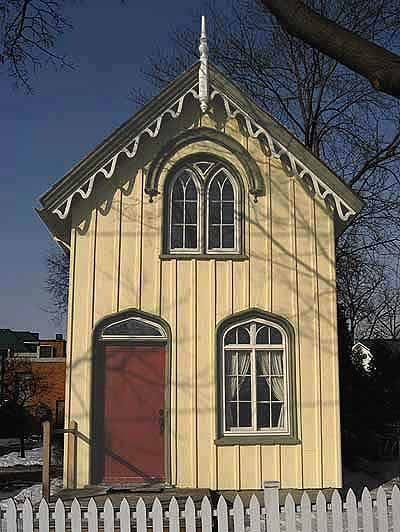
Doctor's
Office Dundas
Also in Dundas, the Doctor's
Office is board and batten with wonderful molding.
Over the top widow is a
drip mould. There are lancet
arches, curved four-centered arches,
and wonderful sills. The building
has been beautifully restored.
The upper window is almost rounded, but it contains
the set of double lancet arches from the Decorated period. On
the lower level, the door and window are both topped with four-centered
arches, as seen in the window at King's College Cambridge. The
roof is topped with a finial, and the vergeboarding on the roof
is a Canadian classic, the ‘droop'. Here is how Marion
Macrae describes this detail in her excellent book The Ancestral
Roof . "The verge boards conjure up visions of many
little buttered hands happily pulling molasses taffy."
|
|
|
Peterborough
Gothic Revival Cottage
The 'droop' can also be found on this wonderful
Gothic Cottage in Peterborough.
The exterior finish on this cottage is also remarkable.
The original casement windows have been covered
with storm windows for protection and climate control.
|

Peterborough Ontario
|
|
Progeston
This house has far fewer Gothic
elements than that above, but it has very steeply pitched
gables, gingerbread
or vergeboarding, and the board and batten finish that was
popular during the era. Board and batten was originally used
in Gothic Revival ecclesiastical architecture - see Carpenter's
Gothic - but it was also used on other structures.
The gable windows have half-rounded
arches, while the first floor bays have segmental arches,
showing an Italianate influence.
|

Progeston Ontario
|
|
Elora
Aside from the lancet
window and the scalloping, this
building shows its Gothic favor through
sheer verticality. The board and batten trim accentuates the
vertical thrust of the walls. The second storey dormers
are also far higher than would be found on equivalents done
in one of the Classical based styles (Neoclassical
or Beaux Arts Classicism).
The store front windows have very large panes
and are probably not original, but the placement of the windows
and the trim has been done to match the original.
|

Elora Ontario
|
|
Port
Hope
Here
is a rare example of a Gothic Revival residence using red brick
instead of stone with white detailing.
The frontispiece
has a stepped gable that holds the
date. The front porch has a door with a low
lancet arch, dripmold, and label
stops. Above the porch is a balustraded
balcony with twin lancet doors. The two other second storey
windows have fractables. The lower
floor has square dripmolds and label stops.
The walls are buttressed
at the corners, and the side walls have bay
windows. There are multiple chimneys
on the roof suggesting that there are many fireplaces.
This is a very early and very
good example of Gothic Revival in a large, well- situated house.
|

Port Hope Ontario
|
|
Vaughan
This Gothic Revival building has been modified
into a residence. The second storey balcony
was added much later, but the original building is clearly 19th
century.
The dichromatic brick
patterns are the most outstanding feature of this building.
Quoins, bands,
blind arches, and a lozenge within
the wider gable all point to Gothic
Revival. The second storey window was added later, and the roof
is new. Quite possibly there were vergeboarding and finials
on the original building.
|

Vaughan Ontario
|
|
Western
Ontario
|
The three gable Gothic style was prevalent throughout
Southern Ontario. The yellow brick produced Western Ontario
gives the towns a
|
|
distinctive style. Red and orange brick was
shipped in from the east. Often this was used in dichromatic
finishes like the farmhouse in Stratford below.
|
|
|
Stratford
The three gable motif is a regular part of the
Gothic Revival repertoire. The vergeboarding on this beautifully
restored building is new
|

Stratford Ontario
|
|
Stratford
originally the house had king posts with trefoil
ornaments. Both gable finishes are effective.
|

Stratford Ontario
|
|
King Post detail
The yellow brick characteristic of Western Ontario
is here used to good effect.
|

Stratford Ontario
|
|
Stratford
Here
is a rare example of a Gothic Revival residence using red brick
instead of stone with white detailing.
The gable has a rare version
of the double lancet window.
|

Stratford Ontario
|
|
Northern
Ontario
|
Variations on the Gothic are found across the
north as settlers arrived both from Europe and from the
east. Fur trading was the major reason for travel in
|
|
the north. Settlers made homesteads along the
lake front and river beds.
|
|
|
claverleigh
Creemore
Outside the urban crush of the city centers stately
homes have a better chance of survival. Claverleigh is one such
example. Set in a clearing in the woods just outside the picturesque
town of Creemore, Claverleigh is one of the very few Gothic
Revival villas in Ontario. It is situated on a large country
estate overlooking the Mad River. The view from the front is
a gently sloping hill which leads into the valley of the river.
A small flower pot lined bridge meanders across the river and
leading to a horse paddock and field. The exterior finish is
board-and batten which emphasizes the verticality of the design.
The wood detailing is finished in bright colours, but the board
and batten is left in natural wood.
|

Creemore Ontario
|
|
Claverleigh
Gothic Revival Villa
The west elevation of Claverleigh looks like a
typical Ontario Gothic Revival Cottage with a central gable
containing a pointed arch window. This entrance leads to a few
fenced in clearings that once protected te livestock.
|

Creemore Ontario
|
|
claverleigh
Creemore
The South elevation is the visitor's entrance.
It is composed of two massive gables with lancet arch windows,
hoodmoulds, kingposts, and decorative vergeboarding. The front
entrance rests between these gables. Two superimposed gables
with lancet arched openings provide a front door and a window
onto the front hall. The door itself is beautifully carved and
protected by both the gable and a substantial wooden hoodmould.
In Early English construction, vergeboards covered
and protected the ridge pole and purlins which projected out
from a gable wall. In Ontario, roof framing did not project
in this way, but the vergeboarding, later called bargeboarding,
was maintained for aesthetic reasons.
The current owners of Claverleigh are doing a
heroic job in restoring the building to its former glory. They
are painstakingly replacing the intricate woodwork surrounding
the doors and windows and perfectly matching the board-and-batten
siding. There is a special place in heaven for people like this.
|

Creemore Ontario
|
|
Gothic
Revival Churches
|
The Gothic Revival can be divided into two groups,
anything done before 1841 was a romantic Gothic. Anything
after 1841 was more or less influenced by the writing of
Augustus Pugin whose many diatribes on medieval construction
were well known to the English speaking world. Pugin and
his followers were convinced that the only true architecture
for northern climates was medieval architecture. Both he
and John Ruskin wrote tirelessly on how Classical architecture
was appropriate for Italy and the Mediterranean, but the
free forms and craftsmanship of the medieval world were
the true architecture for the Christian
|
|
world. Of the four phases of Gothic architecture,
both men preferred the Decorated. Consequently, that is
what we find most of in Canada.
After 1841, it is rare to find a Classical or Renaissance
style church anywhere in the English speaking world. St.
Peter's in Erindale is a good example of a 19th century
Gothic Revival church. It has all the elements of the refined
Decorative style. The windows are decorated with foils or
leafy patterns, the door is carved but not to excess, and
the roof vents have a restrained leaf pattern.
|
|
|
Guelph
Our Lady of the Immaculate Conception in Guelph
(1876) was designed by Joseph Connolly in the French
Gothic Style or "Style Ogivale" as it is known
in France. It has a large rose window,
twin towers, and extravagant statuary
on the front façade. The tympanum
over the front entrance is also carved with religious figures.
Guelph is founded on rock, and so is this cathedral.
Our Lady was meant to occupy the same position
in Guelph as the medieval cathedrals occupied in France. It
was meant as a civic and social center and a national monument
as much as a place of worship. Situated at the top of a hill
overlooking a long boulevard down to the train station, this
building has presence above and beyond that of its intrinsic
beauty.
|

Guelph Ontario
|
|
Our
Lady Guelph
Our Lady was meant to occupy the same position
in Guelph as the medieval cathedrals occupied in Europe. It
was meant as a civic and social center and a national monument
as much as a place of worship. Any town, city or village in
Ontario that was in existence in 1870 will have a church built
in the Gothic style.
|

Guelph Ontario
|
|
Our
Lady Guelph
Twenty-first century Ontarians may have difficulty
in identifying with the 19th century mind set. For most people,
the church was the center not just of spiritual life, but of
social life.
Well into the twentieth century, priests and ministers
were revered and even adored. Before the 1950s, any male film
star worth his salt was cast at least once as the romantic hero
in a movie. Gregory Peck, David Niven and Montgomery Clift all
had a stab at playing a priest and were no less attractive to
their female fans in that role. Cary Grant was an angel. It
is hard to imagine Brad Pitt or Johnny Depp doing the remake.
In fact, ministers were so popular that in 1902, the Globe and
Mail held a contest were participants would write a one page
essay on why their minister was the most attractive man in town.
The prize was an all-expense paid trip to Florida.
|

Kitchener Ontario
|
|
St. Mary Magdalene, Picton,
1834
The first churches in Ontario
were small, box shaped, with either square or round windows.
The first sign of Gothic design in church architecture was the
incorporation of pointed windows instead of the traditional
round ones. The glazing bars of the round headed arch were simply
replaced by interlaced glazing to support the pointed arch.
In later architect-designed churches, this glazing was replaced
by correct Gothic tracery, but many such windows can be found
around the province. They became popular during what is called
the Regency period, in Canada that is between 1830 and 1870,
and thus the style is known as Regency Gothic.
|

(Regency Gothic) Picton Ontario
|
|
Picton
The brick is made in a variety of colours that
reflect the local clay mixture.
The bricks made in the St. Mary Magdalene Picton
were made in a local oven. In 1834, there was no central brick
factory and no way of transporting loads of brick from, say,
Hamilton to Picton.
|

Picton Ontario
|
|
Paris
Regency Gothic
The Paris Plains Church located on a beautiful
plain just outside Paris was called the West Dumfries Wesleyan
Chapel when it was built in 1845. The Chapel itself is a basic
vernacular box shape, the building was an auditory hall large
enough for one preacher and a small congregation. The design
of these towerless box churches was to be seen in the window
and door details. This chapel is a wonderful mix of 19th century
styles.
From a distance it looks like a Gothic Revival
Church simply because of the lancet windows. As in the Picton
church, it is a Regency Gothic design. The overall size and
shape of the building, however, is not. The roof pitch is low,
there is no bell tower, and no other gothic detailing, not even
drip moulds. Because of this it is called Regency Gothic.
The cobblestone exterior finish is unique to the
Paris area being "imported" by Levi Broughton from
New York in 1838. The stonework on this chapel is particularly
impressive considering that it was all done by volunteers from
the congregation.
The elegant, interlacing muntin bars on the lunette
and windows became popular during the Regency period and became
extremely popular as can be seen on the Bolton Chapel below.
The original door was replaced by a well- meaning Italianate
improver some years later.
|


Paris Ontario
|
|
Bolton
Fieldstone was a more usual medium for country
churches, and these generally illustrate exceptional trade skill
as well as tasteful design. Box-shaped country chapels served
the spiritual and social needs of the surrounding community
for many years until advanced transportation made access to
towns more available.
The shutters are shaped
to fit the lancet windows and may
have been closed during storms to protect the multi-paned windows.
These wide lancets were introduced during the Regency period.Corner
buttressing is discreet and understated
to match the tower.
|

Bolton Ontario
|
|
London
Trefoisl
are used in the dormers to add light to the ceiling of this
small church. It is built in the simple country style. Small
abutments are found between the lancet windows.
|

London Ontario
|
|
Cobourg
St. Peter's Church in Cobourg was one of the earliest
Anglican parish churches in Upper Canada. The original frame
church was replaced in many stages by this brick Gothic Revival
structure. The tower and front façade,
shown in this image, were designed by Henry Bowler Lane. They
were constructed in 1844.
The church façade is constructed around
a central buttressed tower. The façade has lancet
windows and doors with hood molds.
A central rose window on the tower is
accentuated by a horizontal band. The
parapets on both the tower and the
aisles are castellated.
|

Cobourg Ontario
|
|
Jordan
St, John's Anglican - Episcopal church was built
on the Niagara Escarpment in 1841. Like the above, this is a
typical rural church made from local stone in the picturesque
medieval style. It is symmetrical, with a central processional
aisle and straight backed pews.
To distinguish it as a Gothic
Revival building, there is battlementing
on the tall, slim, tower and diaper-latticed
lancet windows. The windows are propotionally
quite large for the wall space, letting in a light that floods
the small church beautifully.
|

Jordan Ontario
|
|
Tweedsmuir
Memorial Presbyterian Church
Occasionally there were small churches built in
the Early English style of Gothic Revival as seen in this Presbyterian
church in Orangeville. The original rendering shows the kind
of rural setting needed for a good BBC murder mystery. Miss
Marple could easily be seen walking through the front door of
this beauty with a clue in her hand. Sadly, the church sold
off most of the surrounding property and there is no expanse
of lawn, lich gate or ancient graveyard left for the villain
to run through.
|

Orangeville Ontario
|
|
Tweedsmuir Memorial Presbyterian Church
The church itself could still be used, however,
as both the architect, J.D. Kyles, and the craftsmen were meticulous
in recreating Early English detailing. The plain leaded windows
and rough stone walls are as authentic as any in rural England.
|

Orangeville Ontario
|
|
Tweedsmuir Memorial Presbyterian Church
There is no question that the parish was interested
in reproducing an authentic British church with the intention
of having it be the central focus for at least a portion of
the townspeople. Trying to extract the love for this type of
structure from the largely British population of this town would
be as difficult as trying to get them to forget the lyrics to
Molly Malone or Bonnie Banks of Loch Lomond.
|

Orangeville Ontario
|
|
Perkinsfield
Carpenter's Gothic
Carpenters Gothic is a variation of the Gothic
style in wood. It is also known as Fretsaw Gothic. Very popular
in Lower Canada, new Brunswich and Nova Scotia, it made its
way into the French communities of Northern Ontario like Perkinsfield.
|

Perkinsfield Ontario
|
|
Precious
Blood
Sault St. Marie
The Gothic revival style continued through the
19th century in church design across Canada largely due to the
writings of Ruskin and Pugin. churches are made with local materials
but in a traditional European floor plan.
|

Sault St. Marie Ontario
|
|
Gothic
Revival Extra Reading and Films
|
Books
Blumenson, John. Ontario
Architecture A Guide to Styles and Terms.
1978
Cruickshank, Tom, and John de Visser,
Old Toronto Houses,Toronto: Firefly Books,
2003.
Cruickshank, Tom, and John de Visser,
Old
Ontario Houses,Toronto: Firefly Books,
2000.
MacRae, Marion,
and Anthony Adamson. The
Ancestral Roof: Domestic Architecture of Upper Canada.
Toronto: Clarke, Irwin, 1963.
For information on Gothic Revival architecture
in specific areas within Ontario there are some very
good books listed under the About page.
|
|
Films
Becoming Jane
- Anne Hathaway
The Madness of King
George 1994
"His Majesty was all powerful and
all knowing. But he wasn't quite all there."
Persuasion,
(1995) (2007)
Pride and Prejudice,
(1995) (2005)
Sense and Sensability,
(1995) (2008)
|
|
|